Particle physics does not usually hit the world headlines. But in July 2012, physicists at CERN, the European Organization for Nuclear Research near Geneva, achieved what could be billed as the discovery of the century. Using the Large Hadron Collider (LHC) they found the strongest evidence so far to support a major theory of the structure of matter at a subatomic level.
This most recent success has come after decades of development on the LHC. And over more than fifteen years, Fine Tubes have been developing and supplying high-precision
stainless steel tubes for the all-important cooling system.

The Building Blocks Of The Universe
It is an extraordinary breakthrough, pinpointing a subatomic particle, assumed to be the Higgs boson. They may have isolated one of the most elusive building bricks of the universe, whose existence was predicted by Peter Higgs in 1964 - but whose existence has until now been impossible to demonstrate.
Nicolaas Kos, Mechanical Engineer, Technology Department, CERN:
“Fine Tubes as a company are very constructive and open to new challenges - like performing the high sensitivity leak testing of the tubes. They ensure their products are of the highest specification, which is vital, as these tubes carry supercritical helium inside the ultra-high vacuum in which the particle beams circulate. Even the smallest leakage of Helium into the vacuum would perturb the functioning of the LHC machine.”
Backgrounds
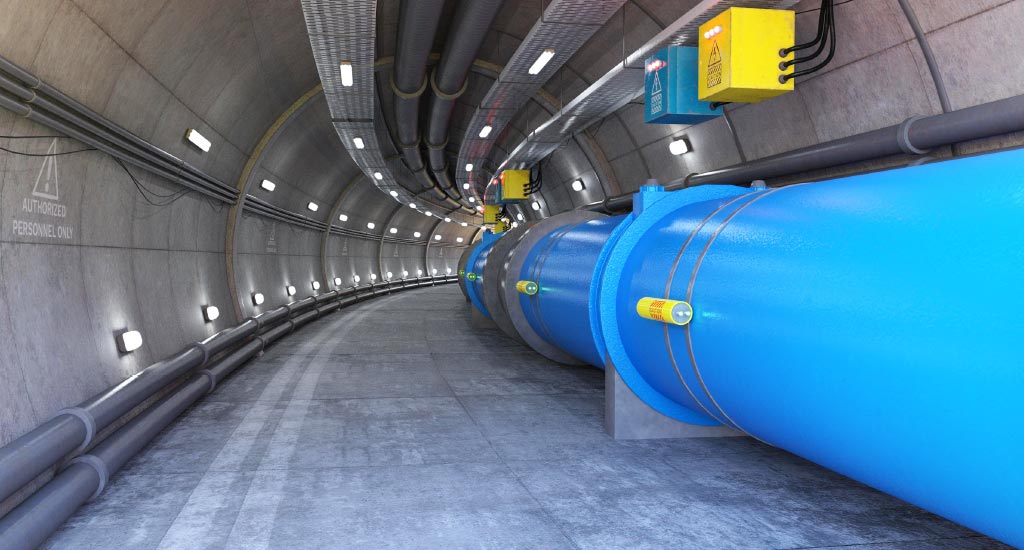
The Large Hadron Collider (LHC) is a particle accelerator considered to be the most powerful experimental physics apparatus ever built. Using it to smash sub-atomic particles helps scientists to understand more about the origin of the universe. It can be found at CERN’s facility, buried underground on the Franco-Swiss border.
Our present knowledge of particle physics leaves many unanswered questions. Cosmological and astrophysical observations have shown that all the visible matter in the universe accounts for only 4 percent of its composition. Physicists are searching for the particles or phenomena responsible for dark matter (23 percent of the universe) and dark energy (73 percent).
A popular theory is that dark matter is made of neutral - but still undiscovered - supersymmetric particles. It is hoped the LHC will answer many questions about the makeup of the universe. It might prove the existence of dark matter and antimatter, helping determine the origin of mass. The results in July 2012 confirm the current thinking about sub-atomic particles, by isolating the Higgs boson.
Challenges
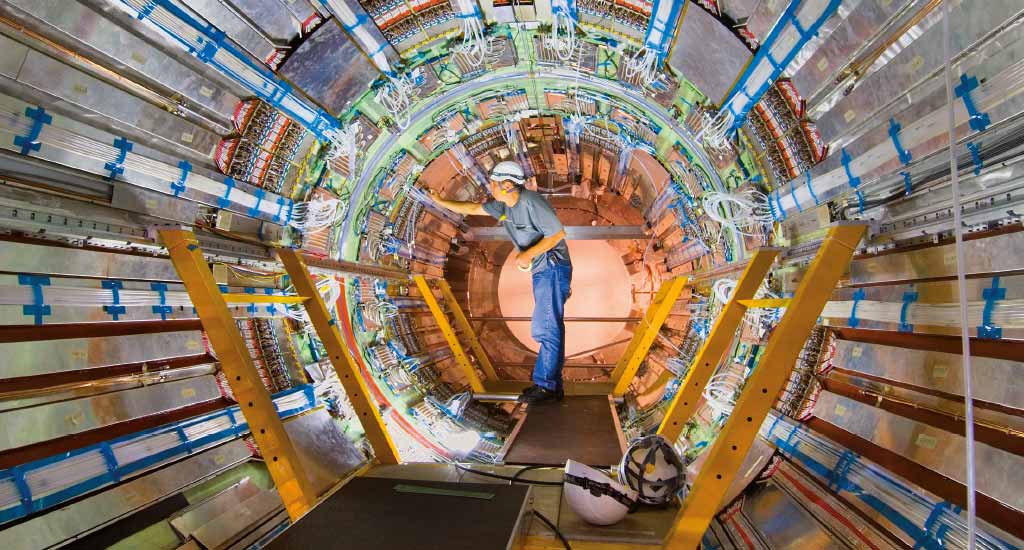
The LHC produces head-on collisions between two beams of particles of the same kind - either protons or lead ions. The beams are created by a chain of accelerators and then injected into the LHC, where they travel through a vacuum comparable to interplanetary space. Superconducting magnets operating at extremely low temperatures guide the beams around the ring.
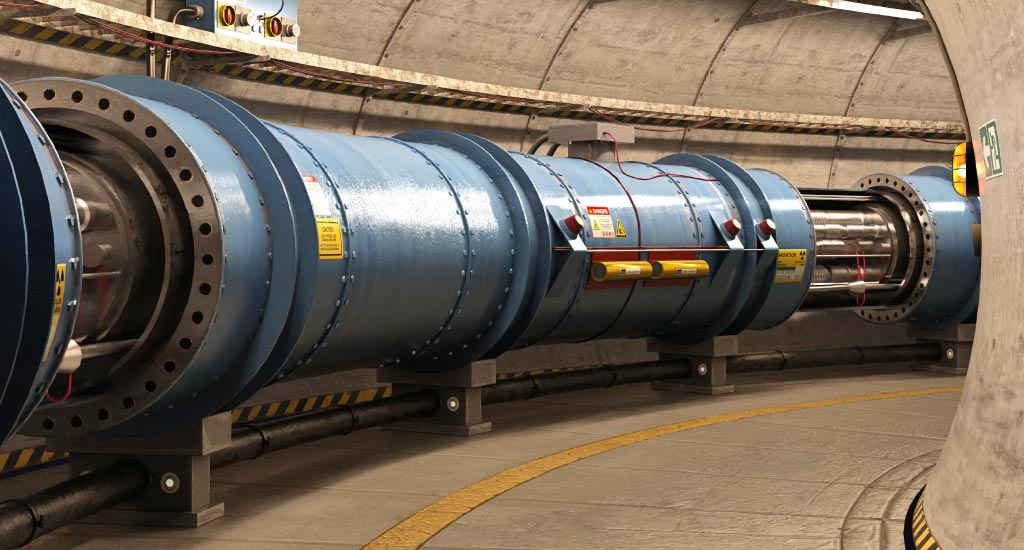
The technology uses superconducting twin-aperture magnets which operate in a superfluid helium bath at 1.98 degrees Kelvin (equivalent to -271 °C). Superfluid helium has a very high thermal conductivity, which makes it an ideal coolant for the refrigeration and stabilisation of large superconducting systems.
Temperatures Colder Than Outer Space
You could say that the central part of the LHC is the world’s largest, coldest fridge. At a temperature colder than deep outer space, it contains iron, steel, and the all-important superconducting coils. The challenge for Fine Tubes was to supply extremely precise tubular components for the LHC beam vacuum system, capable of withstanding the demanding conditions.
The cooling tubes had to be made from a material that could handle the extreme temperatures and pressures involved, while providing high metallurgical cleanliness, very strict leak tightness, and exceptionally low levels of inside and outside diameter halogen contamination.

Solutions
Fine Tubes started making the first prototypes for CERN in 1995. We manufacture the components using a specially formulated stainless steel which provides high mechanical strength and very low magnetic permeability at cryogenic temperatures.
130km Of Precision Cooling Tubes
The cooling tubes are 4.76mm outside diameter with a wall thickness of just 0.53mm. They form part of the Beam Screens, which are inserted into the beam pipes of the collider’s superconducting magnets. These cooling tubes carry a flow of supercritical helium with a temperature between 5 and 20 degrees Kelvin at a pressure of up to 2.6MPa (380 Psi). We supplied a total of 130km of precision tubing for the Large Hadron Collider in straight lengths of up to 15.8m each.
For more information about the latest developments go to www.cern.ch